Context Engineering for Procurement: How to Fix Generic AI Output


In the early days of AI-assisted web design, a strange pattern emerged: almost every website generated by AI looked the same. They all used the same shade of purple, the same generic layouts, and the same hollow stock-photo energy. People started calling this the “purple website” phenomenon. The average of everything on the internet, which, by definition, is mediocre.

Procurement is now hitting its own “purple website” phase. We see teams using AI to draft RFPs, vendor communications, and offer analyses, only to receive outputs that sound professional but are strategically empty. The structure of the RFP docs is fine and the content sounds plausible, but the RFPs are practically useless because they lack something. There is a popular sentence now in the AI community: “AI has no taste”.
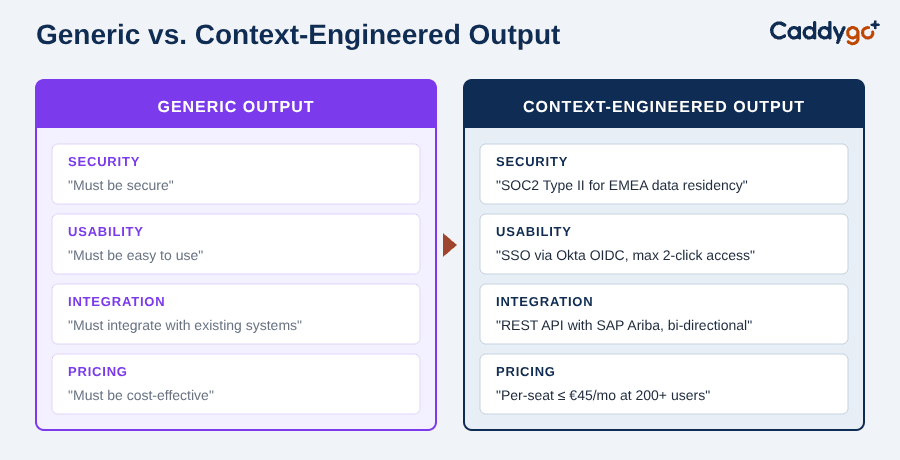
The common first reaction is to blame the model. “ChatGPT or Copilot isn’t quite there yet.” But I don’t think the model is usually the bottleneck. The real problem isn’t the AI’s lack of intelligence (whatever that intelligence is); it’s what you didn’t tell the AI. To fix generic AI procurement output, we have to move past basic prompting toward what’s now called context engineering. It’s about adding the right context to create output that actually reflects your reality.
Why “Context” is the Hardest Part of Any Prompt
Most procurement specialists who have experimented with AI are familiar with some version of the RTCF framework: Role, Task, Context, and Format. It’s a solid baseline. You tell the AI to act as a “Senior Procurement Manager” (Role), ask it to “Draft an RFP for a CRM” (Task), provide some “Context,” and specify that you want it in a “Structured Table” (Format). A reasonably good prompt is the result.
The problem is that Role, Task, and Format are easy to define. They are standard. But “Context” is a fuzzy bucket that most people treat as an afterthought. When the context is thin, the AI starts making its own assumptions. This is exactly when you get plausible sounding output, which lacks “taste”.
And it creates a dangerous gap. Sending a generic RFP signals to vendors that you haven’t done the work, putting your professional reputation at risk. Vendors can smell a generic, AI-generated requirement list from a mile away. If the RFP doesn’t reflect your actual technical constraints or strategic goals, the proposals you get back will be equally generic, forcing you to spend more time fixing the mess during the evaluation phase.
Beyond “Be Specific”: The Four Layers of Procurement Context
“Be more specific” is the most common advice in prompting, but it’s also the least helpful. Simply adding more input files just leads to “prompt overloading,” a pattern where you cram so much into a single message that the AI starts consistently ignoring your instructions.
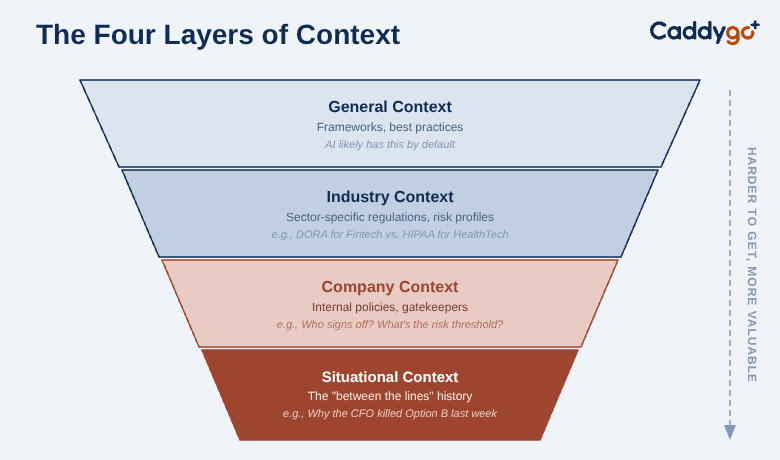
Through our work with procurement teams, we’ve broken the “Context” bucket into four distinct layers that must be engineered separately:
- General Context: This is the textbook layer. Frameworks, best practices, and standard procurement logic. Most AI models already have this from their training.
- Industry Context: The nuances of your specific sector. Procurement for a Fintech firm involves different regulatory and risk profiles than procurement for a HealthTech firm.
- Company Context: Your internal rules of the game. How does your company specifically make decisions? Who are the gatekeepers? What is your standard risk threshold?
- Situational Context: This is the hardest layer. It’s the “between the lines” information. The history of the project, the specific frustration of the business owner, or the outcome of a meeting that happened yesterday.
If you miss even one of these layers, the AI is forced to guess. And when AI guesses, it makes confident-sounding mistakes or reverts to the “purple” average.
Structuring the right information across these four layers before asking AI to do anything is what’s now called “context engineering.” It’s not a new skill for procurement professionals. It’s what the best buyers have always done when briefing a new team member or an external consultant. The difference is that AI needs it spelled out more explicitly.
The Reflection Technique A practical way to fix this is what I call the “Reflection Technique.” Before you let the AI execute a task, give it the context you have and then add one sentence: “Before proceeding with the task, ask me clarifying questions that would help you provide a more precise output”. This triggers the model to identify its own context gaps, prompting you for the exact Industry or Company details it needs to avoid being generic.
Solving the Situational Gap: Capturing What’s “Between the Lines”
Experienced procurement professionals often communicate with each other “between the lines.” In a meeting with a colleague, you might say, “Let’s go with Option A based on yesterday’s chat,” and they know exactly what that means. You have a compound history that allows for more efficient communication.
AI does not have that history. It doesn’t know what was discussed in the hallway or the specific political tension behind a software migration.
Communicating situational context is like onboarding a new hire; you wouldn’t expect them to know the abbreviations and history of a project without a brief. When you treat the AI as an expert who already knows your world, you fail. When you treat it as a brilliant junior newcomer who needs explicit situational onboarding, you win.
The “Between the Lines” gap is why experienced people often struggle most with AI. They intuitively know what to do so well that they forget how to articulate it. The shift from reactive editing (fixing a bad AI draft) to proactive context setting (telling the AI the situational history) is what separates the specialists who find AI “useless” from those who get real value out of it.
This is also an opportunity. The specialists who master context engineering won’t just get better AI output. They’ll position themselves as the people who know how to make the entire team more effective with AI.
Implementation: Why “Relevant Data” Beats “Volume of Data”
There is a common failure pattern I call the “Document Dump.” A specialist uploads 50 PDFs, contracts, security policies, and meeting transcripts, thinking the AI will sift through it all and find the signal.
While AI models can process large amounts of text, they are not magic. If you provide 90% irrelevant noise, the likelihood of the AI focusing on the 10% that actually matters decreases. The AI starts making assumptions about what is important.
Your job is to filter what’s relevant. Your value as a specialist isn’t in sifting through the data; it’s in deciding which data the AI should pay attention to. If you take three minutes to clean the input, extracting only the relevant requirements from a messy business owner’s email and deleting the administrative fluff, the output quality doesn’t just improve slightly; it transforms.
Don’t ask the AI to find the needle in the haystack. Hand it the needle and ask it to sew.
This is where procurement can step up. The specialists who get the input right aren’t just saving time. They’re delivering sharper analysis, faster, and proving that procurement adds strategic value to the business.
Conclusion
Context Engineering isn’t a new burden being added to the procurement specialist’s plate. It is a more rigorous, structured way of doing what the best buyers have always done: managing information to drive better decisions.
The secret to how to fix generic AI procurement output isn’t finding a “better” model or a “magic” prompt. It’s recognizing that the AI is a mirror of the information you provide. If the output is generic, it’s because the input was too broad. By breaking context into the four layers (General, Industry, Company, and Situational) and applying the reflection technique, you stop being an editor of mediocre drafts and start being the architect of elite procurement strategy.
The best prompts aren’t about the model. They are about what you know that the model doesn’t.
Frequently asked questions
Because the input context is too thin. When you give AI only a role, task, and format but little context, it fills the gaps with its own assumptions and reverts to the "average" of its training data — plausible-sounding but strategically empty RFPs and analyses. The fix is context engineering: deliberately supplying the specific context the model cannot infer.
Context engineering is the practice of structuring the right information before asking AI to do a task, rather than relying on a single clever prompt. For procurement it means engineering four distinct layers of context — general, industry, company, and situational — so the output reflects your actual reality instead of a generic template.
They are general context (standard frameworks and best practices the model already knows), industry context (sector-specific regulatory and risk nuances), company context (your internal decision rules and gatekeepers), and situational context (the "between the lines" history of a specific project). Miss any one layer and the AI is forced to guess.
Usually not. Dumping 50 PDFs into a prompt causes "prompt overloading," where the AI starts ignoring instructions and struggles to find the 10% that matters in the noise. Better output comes from filtering to the relevant information first — the specialist's real value is deciding which data the AI should pay attention to.
Before letting the AI execute a task, give it the context you have and add one instruction: "Before proceeding, ask me clarifying questions that would help you provide a more precise output." This makes the model surface its own context gaps so you can supply the exact industry or company details it needs to avoid being generic.
Written by
Data and AI professional since 2016. Built an AI startup in 2020, then trained 100+ procurement professionals at companies like Zalando and Novonesis on AI adoption.

