Why Internal AI Procurement Builds Fail


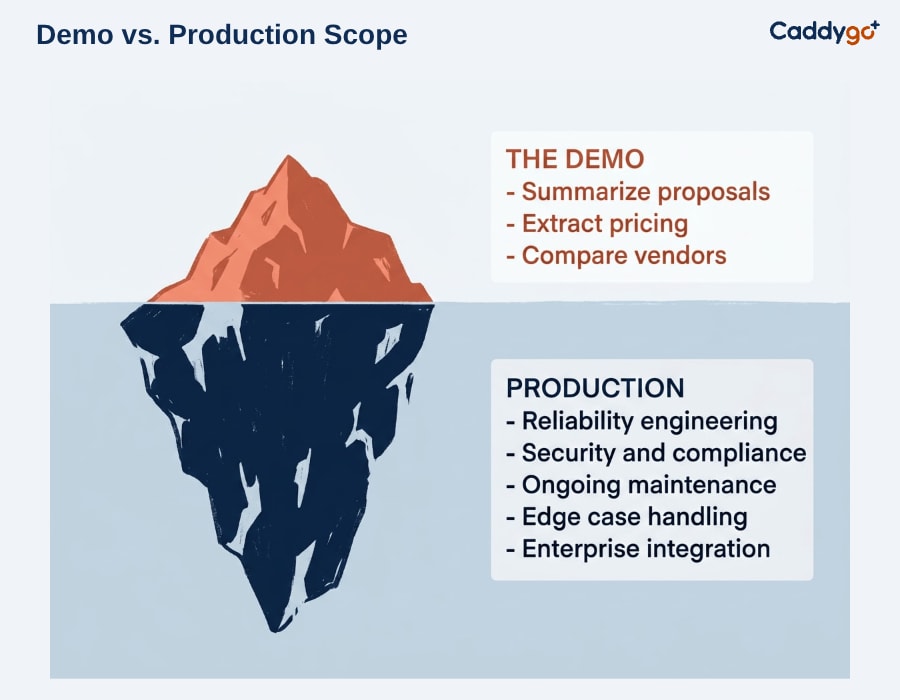
Building a working AI prototype has never been easier. An internal team can have a functional demo running in days: summarizing proposals, extracting pricing, comparing vendor responses. The output looks good. The logic feels sound.
But what that prototype actually proves is that the easy part works. The gap between a demo that runs on clean data and a system your procurement team can rely on daily is where most internal AI procurement builds fail. Gartner found that over half of generative AI projects were abandoned after proof of concept by the end of 2025, and that’s across all industries, not just procurement. And that gap is wider than the prototype suggests.
The real scope doesn’t become visible at launch. It surfaces over the following months, as the system encounters the kind of variation that clean demo data doesn’t prepare it for. The full cycle from prototype to understanding the true production requirements typically takes 12 to 18 months. By then, the team has invested heavily in something that competes with their core responsibilities.
What Surfaces After the Demo
No AI system gets it right 100% of the time. Humans don’t either. That’s not the issue. The issue is what happens when a system fails 5% of the time and you don’t know which 5%. A missed clause in one vendor comparison, a pricing error in another. In a demo, those failures don’t appear. In production, they show up across real processes. And because you can’t predict when they’ll appear, you end up needing to review everything.
That changes what the engineering problem actually is. It’s not about making the AI more accurate. It’s about building a system where the AI flags where it’s likely wrong, so a specialist can focus on the cases that need attention. That’s a human-in-the-loop design problem, and it’s a hard one. It means building the system to detect its own uncertainty, route the right cases to the right people, and learn from corrections over time. Internal builds almost never go to that depth. Most stop at a basic tool that gives you outputs but doesn’t tell you which ones to trust.
Then comes maintenance. AI systems need constant updates: new model versions, changing data patterns, evolving compliance requirements, security patches. Building the initial tool is a small fraction of the long-term effort. Keeping it reliable is the hard part, and it never ends. Every month, that maintenance competes with every other project on the IT team’s backlog.
The Focus Gap
Internal IT teams are rarely short on talent, but they are always short on focus. When a specialized vendor solves one problem full-time, they get better at every engineering decision along the way. Multiply those incremental improvements across hundreds of decisions in a product, and the cumulative advantage is significant.
Internal teams are usually managing ten or more projects at the same time. They don’t have the capacity to go deep on the specifics of vendor Q&A management, making evaluation criteria comparable across proposals, or pricing benchmark comparisons. A specialized team does.
There’s also the problem of finding the right people. The intersection of deep procurement domain knowledge and AI engineering expertise is rare. If you manage to hire or develop someone with both, they become highly sought after. When they leave, your internal tool doesn’t just stop improving. It starts to deteriorate. The knowledge that made the system work walks out with them.
What Only Cross-Customer Learning Can Build
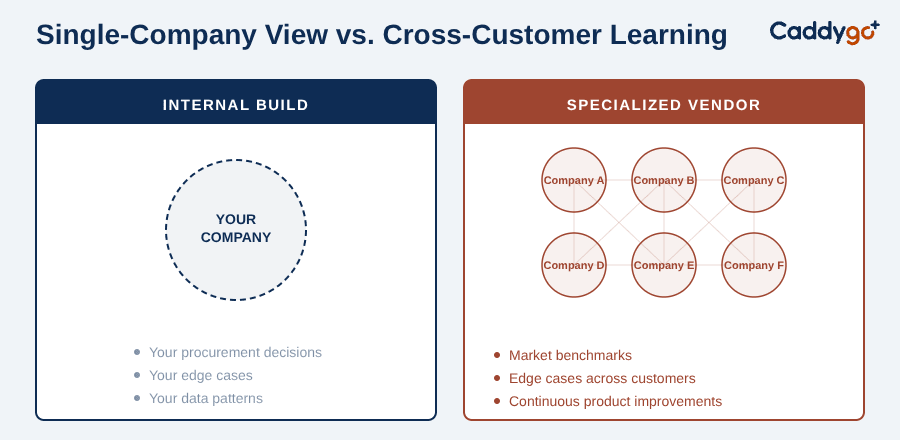
An internal tool learns from one company’s procurement decisions. To go beyond that, you need external data: market benchmarks, pricing databases, industry reports. That data exists and you can buy it. But now you’re maintaining an internal AI build and integrating third-party data sources, which adds complexity and defeats much of the purpose of building internally in the first place.
A specialized vendor doesn’t have that problem. The entire product is built around cross-customer learning from the ground up. Every edge case one customer encounters improves the system for the next. The data, the product improvements, and the features all come from that experience across customers. An internal build would need to replicate that integration on top of everything else.
The Real Cost of Building Internally
The decision to build internally is often framed as a way to save money or maintain control. But even on a direct comparison, the internal build often doesn’t come out ahead.
For most companies, procurement is not the core business. IT teams have higher-priority projects: customer-facing products, infrastructure, security, compliance systems. The procurement AI tool is rarely at the top of that list. And even with AI coding tools now generating large parts of the code, the result isn’t fewer projects. It’s more tools to build and more tools to maintain. The backlog gets longer, not shorter. An internal procurement build has to compete for attention against all of that.
Then there’s the opportunity cost. Every month the internal tool isn’t ready for daily use is a month where procurement runs on manual processes. The development budget is the visible cost. The less visible one is everything that doesn’t improve in the meantime: slower turnaround for business owners, weaker data for negotiations, a procurement process that falls behind what’s available on the market.
To be clear: not every internal build is the wrong decision. If a team can build something simple and isolated that their procurement specialists can maintain themselves, AI gives them new capabilities that didn’t exist before. That can make perfect sense.
The problem is that many teams underestimate the complexity and draw the make-or-buy line in the wrong place. A prototype that works in a demo makes the full build look closer than it is. The question isn’t whether the internal team could build something. It’s whether the organization will sustain it when it’s competing against projects closer to the company’s core business.
Getting this decision right is one of the most impactful things a procurement leader can do right now. That means building the expertise to identify exceptional solutions and being clear-eyed about the limitations of building internally.
Frequently asked questions
Because a working demo only proves the easy part works. The gap between a prototype running on clean data and a system a team can rely on daily is wide — Gartner found over half of generative AI projects were abandoned after proof of concept by the end of 2025. The real requirements surface over 12 to 18 months, by which point the build is competing with the IT team's core priorities.
The failures a demo never shows: a system that is wrong 5% of the time when you cannot predict which 5%, which forces you to review everything. That turns the problem from "make the AI more accurate" into a human-in-the-loop design challenge — detecting its own uncertainty, routing cases to the right people, and learning from corrections — plus constant maintenance that most internal builds never reach.
It depends on scope. If a team can build something simple and isolated that its own specialists can maintain, an internal build can make sense. But many teams underestimate the complexity and draw the make-or-buy line in the wrong place, because a demo makes the full build look closer than it is. The real question is whether the organization will sustain it against projects closer to its core business.
Internal IT teams are rarely short on talent but always short on focus, typically juggling ten or more projects at once. A specialized vendor solving one problem full-time makes better engineering decisions at every step, and those improvements compound across hundreds of product decisions. Internal teams also struggle to retain the rare people who combine procurement domain knowledge with AI engineering.
Cross-customer learning. An internal tool learns only from one company's decisions, while a specialized product is built around learning from patterns across hundreds of procurement teams — every edge case one customer hits improves the system for the next. Replicating that internally means buying and integrating external benchmarks and data on top of everything else, defeating much of the point of building internally.
Written by
Data and AI professional since 2016. Built an AI startup in 2020, then trained 100+ procurement professionals at companies like Zalando and Novonesis on AI adoption.

