Why Reviewing AI Output Demands More Procurement Expertise


There is a widespread fear in and beyond procurement that AI will de-value human skills we spent years acquiring. The logic seems straightforward: if a machine can analyze an offer, draft an RFP, and review contracts, the human expert becomes an expensive, redundant middleman. The assumption is that AI makes the job “easier” and therefore requires less of the person doing it.
As we build Caddygo, we’re observing the exact opposite. What we’ve discovered is an Expertise Paradox: automating the administrative “grind” doesn’t lower the bar for human buyers. It moves it significantly higher. When you shift from doing a task to reviewing the output of a digital colleague (or: AI agent), you aren’t doing less work; you are performing a harder kind of review that requires deeper category knowledge than the manual process ever did.
Effort is no longer the metric for rigor. The future of procurement isn’t about how many hours you spent in a spreadsheet; it’s about your judgment when the AI hands you the results.
Now there is an incredible opportunity for procurement to elevate its game and position itself as a strategic function that delivers impact and value to companies - with AI.
Why AI Moves the Bar Up
For decades, a big part of the procurement specialist’s value was tied to the “invisible grind.” You read the 50-page proposals, you manually built the Excel comparison matrices, and you normalized the data line by line. It was tedious, but it was how you proved you were “doing the work.”
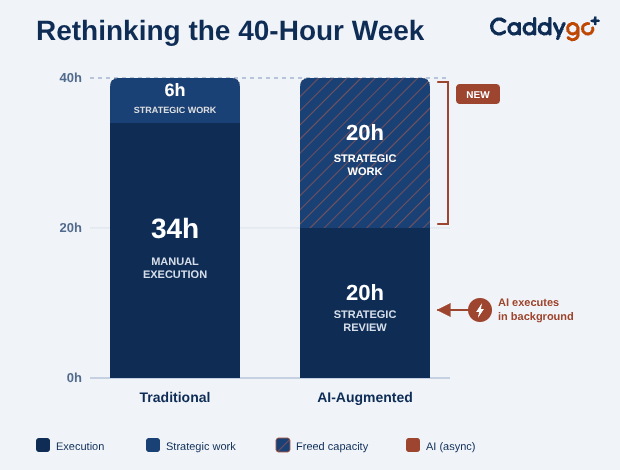
But “doing the work” and “applying expertise” are not the same thing. In fact, we all get tired, and tired reviewers miss things. A specialist three hours into reviewing a complex offer is arguably less rigorous than an AI agent that doesn’t get tired. With AI, we are seeing a fundamental shift toward higher productivity, whereas AI is far faster than human beings to generate output for the vast majority of tasks. As a conclusion, we see an increased volume of work to be reviewed by humans.
This means the human role shifts from doing to reviewing for most of the tasks we were used to doing ourselves. And here’s the catch: You can only properly review what you could do yourself. While spending three days on a 50-page PDF used to be the metric for rigor, it’s now a liability that hides risk through slowness. True expertise now manifests in the ability to challenge the AI’s output, catch the subtle risks it might miss, and ensure the final selection is based on the “full picture” that exists outside of a PDF. On a side note: In practice, I think the new way of working will enable more strategic work beyond reviewing AI output(!).
The Cognitive Trap: Why Reviewing is Harder Than Doing
There is a specific type of mental fatigue that comes with reviewing AI output that people don’t talk about. In the industry, we often assume that “clicking approve” is easier than writing from scratch. I don’t think that’s actually the case.
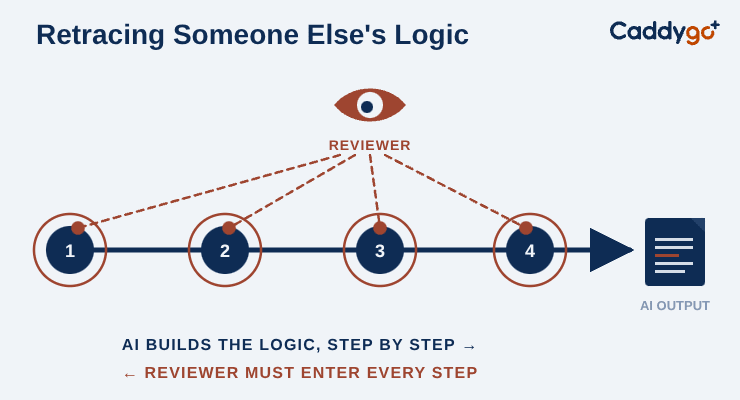
What we’ve observed is that reviewing is a high-intensity cognitive task. When you do a task yourself, you follow your own train of thought. You know why you reached a certain conclusion because you built the logic step-by-step. When you review an AI’s output, you have to retrace its thinking. You have to audit their decision patterns and verify their data points without having lived the process of finding them. Let’s think of an easy example: Have you ever tried giving a presentation that you haven’t crafted yourself? It’s immeasurably harder than presenting a Powerpoint you built.
The described shift creates a new demand for procurement expertise. If you haven’t mastered the category, you can’t audit the output; you can only guess. Junior staff, in particular, face a steep challenge: how do you learn to review a task you’ve never been asked to do manually? We are moving away from the “learn by doing” model of onboarding. If the AI handles the 50-page document analysis, the junior buyer needs to develop “reviewer skills” years earlier than previous generations did.
Reviewing isn’t a passive task. It is a strategic gate. If the person at the gate doesn’t have the expertise to spot a confident-sounding mistake or a missed risk factor, the automation becomes a liability. AI needs a reviewer it can trust, just as much as a senior manager needs a buyer they can trust.
Your Standards are the AI’s Ceiling
The quality of AI’s output is capped by mainly two things: the context you provide and the standards you hold it to during the review.
General AI tools are trained primarily on public data, but procurement happens in the gaps: the company-specific context, the industry-specific risk factors, and the “situational context” that only exists in the head of the specialist and their stakeholders. If a specialist fully trusts AI and skips the review, the output becomes a professional risk.
Sending “half-reviewed” AI output to a business owner or, worse, a vendor, is a massive risk to your credibility. It’s actually better to send nothing at all than to send a plausible-sounding document that you haven’t rigorously challenged. Inconsistent, unverified output doesn’t just damage your reputation; it damages vendor relationships in the worst case.
The Expertise Filter
The Expertise Paradox is ultimately a filter for the profession.
Buyers who use AI to replace their knowledge will find themselves sidelined. They will produce “plausible” but mediocre work that eventually collapses under the first sign of real-world complexity. However, the buyers who use AI to leverage their knowledge will become the new standard.
We are moving into a world where expertise is measured by your ability to guide and challenge AI, not by your ability to out-work it on a spreadsheet. Manual document diligence is dying. What’s taking its place is a much more demanding, much more visible, and much more strategic version of procurement.
Frequently asked questions
No — it raises the bar. This is the Expertise Paradox: automating the administrative grind shifts you from doing a task to reviewing the output of a digital colleague, which is a harder kind of work that demands deeper category knowledge than the manual process ever did. You can only properly review what you could have done yourself.
Because when you do a task you follow your own train of thought and know why you reached each conclusion. Reviewing means retracing someone else's reasoning — auditing their decision patterns and verifying their data points without having lived the process of finding them. It is a high-intensity cognitive task, not the easy "click approve" people assume.
It is a serious risk to your credibility. A plausible-sounding document you have not rigorously challenged can carry confident-sounding mistakes and missed risks, and it is better to send nothing at all than to send unverified output. Inconsistent, unverified output damages both your reputation and your vendor relationships.
It is a real challenge, because the "learn by doing" model breaks down when AI handles the manual document analysis juniors used to cut their teeth on. They need to develop reviewer skills — the ability to audit and challenge AI output — years earlier than previous generations did, which means deliberately building category mastery rather than leaning on the AI.
Two things: the context you provide and the standards you hold it to during review. General AI is trained mostly on public data, but procurement happens in the gaps — company-specific context, industry risk factors, and situational knowledge that lives in the specialist's head. In practice, your standards are the AI's ceiling.
Written by
Data and AI professional since 2016. Built an AI startup in 2020, then trained 100+ procurement professionals at companies like Zalando and Novonesis on AI adoption.

