How to Improve Your RFP Process: 7 Practical Steps


It is tempting to improve an RFP process from the back end: better scorecards, faster reviews, tighter evaluation. That work matters, but it treats the symptoms. The quality of an RFP outcome is mostly set earlier, by how clearly you defined what you needed before the document ever went out. The most effective way to improve your RFP process is to invest more in the requirements and the draft, standardize the document and the scoring, and run a tight, fair evaluation, so that vendors answer the same question and you can compare offers on the merits. This guide walks through the practical steps that make an RFP process faster and more reliable, and the one stage where the biggest gains hide.
Where the RFP process actually breaks down
When an RFP process goes wrong, the pain usually shows up late, but the cause sits at the start. A few patterns come up again and again in the procurement teams we have worked with.
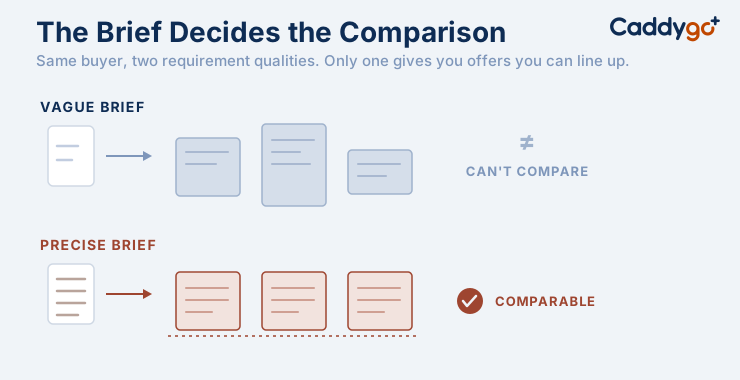
Vendors answer different questions. When requirements are loosely defined, each vendor interprets them their own way. One team described suppliers who misread the specification and priced the wrong scope, which made the offers impossible to line up side by side. No amount of careful reading later recovers a comparison that was never built in.
The clarification back-and-forth explodes. Vague requirements do not remove work, they defer it. In one software sourcing event, the buyer received twenty-six clarification questions from vendors after publishing, then had to chase several internal departments to answer them. Two of three vendors asked for a deadline extension almost immediately, which is a reliable signal that the document was not clear enough to act on.
Offers arrive as walls of paper. Without a fixed response structure, vendors reply in whatever format they prefer. Responses running past two hundred pages are common, and someone has to read every one of them.
Scoring turns subjective. When the evaluation criteria are not agreed in advance, a panel of eight or nine reviewers ends up scoring on gut feel, with no shared weighting, so the result depends on who was in the room that day.
The timeline slips. In the worst case, unclear requirements force a full re-issue. One large services tender had to run three separate RFP rounds before the requirements were solid enough to compare offers against.
How to improve your RFP process, step by step
Improving an RFP process is less about any single tactic and more about removing the friction above at each stage. Seven changes do most of the work.
1. Make the requirements measurable before you draft the document. Good proposals depend on good requirements. Translate broad goals into concrete ones: not “reduce cost” but “cut unit cost by ten percent,” not “must be secure” but “must support single sign-on from day one.” Pull input from the people who will live with the decision, such as the business owner, finance, IT, and legal, in one short kickoff, so the requirements are realistic and complete before anything goes out. This is the highest-leverage step in the whole process, and the next section explains why it is also the one most teams cut short.
2. Standardize the template and the response format. A reusable RFP template does two jobs at once: it speeds up drafting, and it forces every vendor to answer in the same structure. Give vendors a fixed response format, for example a pricing table with defined line items, a compliance checklist, and a capabilities section, so offers come back comparable by design rather than by luck. Keep a library of proven sections you can reuse across events, and adjust the specifics to the category rather than starting from a blank page each time.
3. Assemble a small team and assign clear roles. Large committees slow RFPs down and blur accountability. A focused group of four to six people, with named owners for drafting, scoring, and contract review, moves faster and keeps decisions clean. Agree up front who scores which sections, so the evaluation does not stall while people work out who is responsible for what.
4. Set the scoring criteria before you issue. Decide how you will evaluate offers, and the weight of each criterion, before the RFP goes out, not after the responses land. Writing the scorecard first has a useful side effect: it exposes gaps in your requirements while you still have time to fix them. If you cannot say how you would score an answer, the underlying question is probably not specific enough yet.
5. Run vendor questions centrally and fairly. Vendors will have questions during the tender. Collect them in one place, answer in writing, and share every answer with all bidders. Answering privately creates an unfair process and invites disputes later. A well-run question round also shows you exactly where your requirements were unclear, which is useful input for the next RFP.
6. Set realistic timelines. Give vendors enough time to respond well, and build in buffer for the question round and internal scoring. Most vendors can turn around a solid proposal in about two weeks when the requirements are clear. When teams are forced to grant extensions, unclear requirements are usually the reason, not the calendar.
7. Debrief after every RFP. Once an event closes, run a short internal review: what took longest, where the back-and-forth happened, which questions vendors kept asking. Offer unsuccessful vendors constructive feedback as well, so strong suppliers stay willing to bid next time. Each debrief feeds the next RFP, and these small corrections compound faster than any one-off fix.
The biggest gains happen before you hit send
Look back at the failures in the first section. Non-comparable offers, the clarification pile-up, subjective scoring, the re-issue. Almost all of them are set in motion before a single vendor sees the document. You can run a flawless evaluation and still get a poor result if the requirements you sent out were vague. A weighted scorecard applied to offers that answer different questions is tidy-looking guesswork. This is why requirements are not simply the first item on a checklist. They cap how much value every later step can add. The effect reaches well beyond procurement: the Project Management Institute finds inadequate requirements to be among the most-cited causes of failed projects.
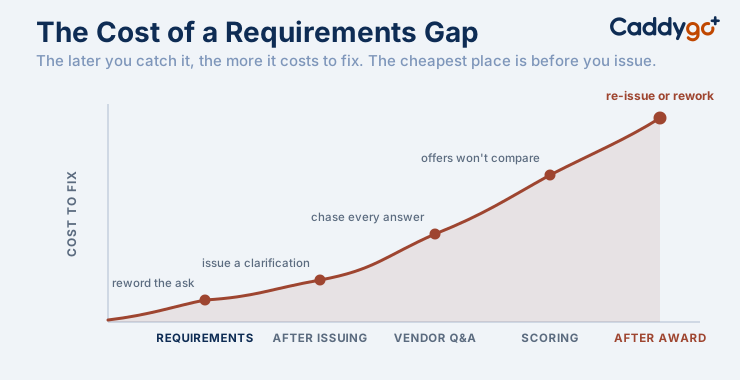
So if the requirements stage is this decisive, why do teams keep cutting it short? The reason is not carelessness. Teams compress requirements because they are acting economically, and the economics are genuinely hard.
Two forces pull against a thorough draft. The first is expertise. For complex categories, especially in indirect procurement such as software, professional services, or marketing, the procurement lead is often not a deep expert in what they are buying. Coming up with a first draft of the right questions is legitimately difficult when you have never sourced that category before. (Direct procurement, where teams buy the same components again and again, is a different story.) The second force is time and internal goodwill. Good requirements depend on the business stakeholders who actually know the need, but they are often pulled in late, or hand over a thin brief to begin with, and procurement inherits the clarification loops that follow. Even a complex fifty-thousand-euro software purchase cannot justify sinking fifteen workdays into its requirements, yet that is roughly what one business lead had to spend when no procurement support was available. Push too much of that work back onto stakeholders, though, and they start to see procurement as a source of extra work rather than help, which is the opposite of what a growing function is trying to prove. So requirements get compressed, the draft goes out thinner than it should, and the cost resurfaces later as vendor questions, mismatched offers, and rework.
Seen this way, “write better requirements” stops being a platitude. What actually moves the needle is making a strong first draft cheap: getting to the right questions, and the right people to answer them, without turning every sourcing event into a two-week research project. That is where the leverage in the whole process sits.
It is worth being honest about what a better draft does not fix. It will not stop a vendor from submitting pricing in their own format and pushing the work of making offers comparable back onto you. It will not close the information gap in negotiation, where you rarely know the real market price. And it will not resolve the internal politics that shape some decisions before an RFP is even written. Getting the requirements right removes the self-inflicted problems. The others remain their own work. Still, the upside is real: a team that gets the front end right runs fewer, cleaner RFPs, spends its judgment where it genuinely counts, and starts to be seen as the function that makes sourcing easier rather than the one that slows it down.
How to measure whether your RFP process is improving
You cannot improve what you do not measure. A few practical signals tell you whether changes to your RFP process are working:
- Cycle time. The number of days from issuing the RFP to awarding the contract. The clearest single measure of overall efficiency.
- Clarification volume. How many questions vendors ask after publication. A falling count is direct evidence that your requirements got clearer.
- Comparability. How easily you can line offers up against your scorecard. If you still spend days normalizing pricing and scope by hand, the front end needs more work.
- Re-issue and extension rate. How often you have to re-run a round or grant deadline extensions. Both are clarity symptoms more than scheduling ones.
- Stakeholder and vendor satisfaction. Whether business owners feel procurement helped them, and whether strong vendors keep bidding. If good suppliers stop responding, the process has become too burdensome to be worth their time.
Track a few of these across several events. The trend over time, rather than any single number, tells you where to focus next.
Improving the RFP process, going forward
Improving an RFP process is not about adding more steps. It is about putting the clarity in early, so every later step gets easier: precise requirements, a standard structure, criteria set in advance, and a fair, well-run evaluation.
The reason that upfront clarity has always been hard is cost. Getting to a strong first draft for a category you rarely buy used to mean days of digging for the right questions, leaning on whoever happened to know the space, or paying a consultant for expertise you had no time to build. That is exactly what made requirements the step teams cut short. It is also the cost that is now falling fast: a procurement lead can sit down with an AI tool and get a solid first draft of the questions worth asking for an unfamiliar category in hours rather than the two-week research project it used to be, along with a clear view of who needs to answer them. You still make the judgment calls and still own the requirements. You no longer have to be a deep expert in the category to send out a brief specific enough to get comparable offers back. That is what turns “write better requirements” from good advice into something a lean team can actually do on every RFP.
Frequently asked questions
Give every vendor the same response format and set your scoring criteria before you issue the RFP. Define pricing as fixed line items rather than a free-form quote, so vendors cannot answer in their own structure. Comparability is built at the drafting stage, not recovered during evaluation.
Keep the team small, usually four to six people, with the business owner and the relevant functions such as finance, IT, or legal. Involve them early, in a short kickoff before the RFP is drafted, so the requirements are realistic, and assign clear roles for drafting, scoring, and contract review.
It depends on the complexity of the category, but most vendors need about two weeks to respond well. When RFPs drag on or need extensions, unclear requirements are usually the cause rather than the timeline itself. Clearer requirements up front are the most reliable way to shorten the whole process.
Written by
Data and AI professional since 2016. Built an AI startup in 2020, then trained 100+ procurement professionals at companies like Zalando and Novonesis on AI adoption.
