Vendor Scorecard: How to Build One You Can Trust


A vendor scorecard turns a messy pile of proposals into a single number, and the number feels objective. That is exactly what makes it useful, and exactly where it can quietly go wrong. A score is only as good as the review that produced it, and two people scoring the same offer on a busy week rarely land in the same place.
A vendor scorecard is a structured tool procurement teams use to rate and compare suppliers against weighted criteria such as quality, cost, delivery, compliance, and service, so vendor decisions rest on evidence rather than gut feel. Teams reach for it in two moments: to choose between competing offers during a tender, and to keep track of the suppliers they already work with. This guide covers what to measure, how to build one step by step, and the part most scorecards get wrong: the review sitting underneath the score.
What is a vendor scorecard?
Mechanically, a scorecard is simple. Each criterion gets a score, each criterion carries a weight, and the weighted total lets you line up several vendors side by side or track one vendor over time. What makes it worth doing well is the two jobs it does, which are easy to confuse.
It helps to separate two things that share the name. An evaluation scorecard is used once, at selection, to compare competing offers and pick a vendor. A vendor performance scorecard is used repeatedly, after the contract is signed, to track whether a supplier keeps delivering on quality, timeliness, and service. The criteria overlap, but the purpose differs: one chooses a vendor, the other holds a vendor accountable. Most teams need both, and the structure below applies to either.
The value is comparability. When every vendor is measured against the same criteria at the same depth, the differences between them become visible instead of anecdotal. Without that structure, a decision tends to drift toward whichever proposal was read most carefully or whichever salesperson was most persuasive, which is not the same as whichever vendor is best.
What a vendor scorecard measures: the core criteria
Good vendor scorecard criteria fall into four groups. The exact metrics change by category, since evaluating a logistics provider is not the same as evaluating a software vendor, but the four groups hold up across almost any indirect spend.
| Criteria group | What it covers | Example metrics |
|---|---|---|
| Technical / quality | Whether the vendor can actually deliver what you need | Fit to requirements, quality of the work or product, relevant certifications, track record, references |
| Commercial | The full cost picture, not just the headline price | Pricing model, total cost of ownership, payment terms, volume discounts, bonus and penalty terms |
| Service levels | What happens once the work is underway | Response and resolution times, support availability, service or delivery guarantees, account management |
| Compliance / risk | The obligations and exposures behind the deal | Data protection, regulatory compliance, financial stability, insurance, information security where relevant |
A few principles keep this list useful rather than bloated:
- Technical usually leads. If the core requirement is not met, the rest does not matter, because the service will not work. In most categories the technical or quality group carries the most weight.
- Measure total cost, not price. A cheaper headline number with weak payment terms, thin support, or a short contract can cost more once you weigh the total cost of ownership rather than the purchase price alone. The commercial group exists to surface that.
- Score what the vendor controls. A criterion the supplier cannot influence adds noise, not signal. Rating a vendor on an outcome shaped mostly by your own team tells you little about the vendor.
- Keep it lean. Scorecards tend to grow by accumulation, with each stakeholder adding a metric until the picture blurs. A focused set of criteria that everyone understands beats an exhaustive one that no one maintains.
Knowing what a weak answer looks like is as useful as knowing the criteria. A vendor can score well on the surface and still raise flags: a low headline price paired with payment terms that quietly shift risk onto you, references that all trace back to a single industry or a single project, a certification that has lapsed, or a support promise that turns out to be business-hours-only once you read the detail. Scoring each area explicitly is what makes those signals visible, instead of letting a confident proposal paper over them.
The criteria are the columns of your scorecard. Get them wrong, or leave them vague, and everything downstream inherits the problem.
How to build a vendor scorecard, step by step
A vendor scorecard is straightforward to build and easy to build badly. These six steps produce one that holds up.
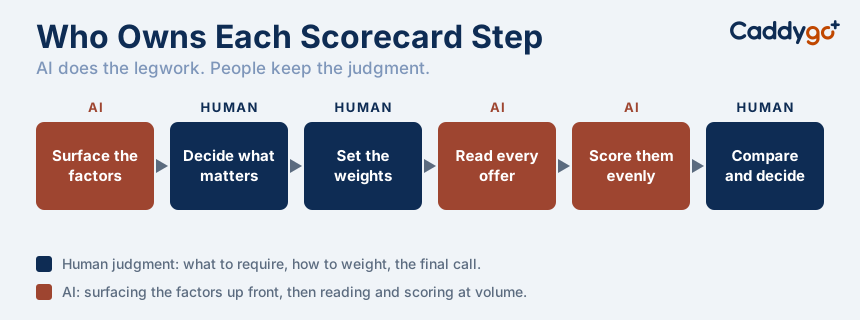
1. Define what you are buying and surface the factors. Before any criteria, get specific about what you actually need: the specification, the questions vendors must answer, and the legal and security obligations. For a familiar category this is quick. For something the team has not bought before, this is the hardest and most valuable step, because it decides who inside the business you need to involve and what to ask them.
2. Turn requirements into criteria with stakeholders. Procurement usually builds the scorecard template and the relevant stakeholders fill in the content. The business owner defines the technical must-haves, security defines the compliance line, finance shapes the commercial terms. Mark which criteria are hard requirements and which are preferences, because that distinction drives the scoring method later.
3. Set the weighting. Assign each criteria group a share of the total, for example technical 40%, commercial 30%, service levels 20%, compliance 10%. Weighting is where business priorities become explicit. It is also where different stakeholders will disagree, which is a feature rather than a bug, as long as the disagreement is resolved deliberately rather than by whoever fills in the sheet last.
4. Choose a scoring method. Three methods work well together:
- Must-have knock-outs. If a hard requirement is not met, the vendor is out, regardless of how well it scores elsewhere. This filter runs first.
- A numeric scale. Rate each remaining criterion, commonly 1 to 5 or 0 to 100%, where the top of the scale means the vendor fully meets or exceeds the requirement. Agree up front what each point means, so a 3 from one reviewer means the same as a 3 from another. Vague scales are where two people rate the same offer differently.
- A weighted average. Multiply each score by its weight and total them for a single comparable result.
5. Score with more than one set of eyes. Where you can, have each group scored by the team that owns it: the business owner rates the technical criteria, procurement rates commercial, legal or security rates compliance. Distributing the scoring reduces individual bias and, just as usefully, removes most of the internal argument, because each number has a clear owner and a clear rationale.
6. Set a cadence and act on the result. For selection, the scorecard feeds the comparison and the decision. For ongoing performance, agree how often you review, quarterly is common, and what a good or bad score triggers. A scorecard that never changes a decision is just paperwork.
Here is how a simple weighted vendor scorecard looks with two vendors scored 1 to 5:
| Criteria group | Weight | Vendor A (score → weighted) | Vendor B (score → weighted) |
|---|---|---|---|
| Technical / quality | 40% | 4 → 1.60 | 5 → 2.00 |
| Commercial | 30% | 3 → 0.90 | 2 → 0.60 |
| Service levels | 20% | 5 → 1.00 | 3 → 0.60 |
| Compliance / risk | 10% | 4 → 0.40 | 5 → 0.50 |
| Weighted total | 100% | 3.90 | 3.70 |
Vendor A wins, even though Vendor B scored higher on the single most heavily weighted group. Notice what is doing the work here. Raise the weight on technical, or lower it on service levels, and the winner flips. The math is mechanical, but the weights are a judgment call, and they decide the outcome as much as the scores do.
One rule sits above this math: the must-have knock-out. Imagine a third vendor that scored highest of all on both technical and price, but could not meet a data-protection requirement the business had marked non-negotiable. Its weighted total is irrelevant. It is out before the averaging even starts. Knock-outs run first for exactly this reason, so a strong score in one area cannot quietly buy back a failure on something you already decided you would not compromise on.
Types of vendor scorecards
Scorecards vary with what you need from them. The main distinctions:
- Evaluation vs. performance. As above: an evaluation scorecard selects a vendor from competing offers, a performance scorecard tracks a signed vendor over time. Same structure, different moment.
- Basic vs. advanced. A basic scorecard rates a handful of criteria on a simple scale. An advanced one adds weighting, knock-outs, sub-criteria, and trend tracking. Start basic and add structure only where it earns its keep.
- Manual vs. automated. A spreadsheet is fine to start and quick to build. As the number of vendors and documents grows, manual scoring becomes the bottleneck, and teams move to tooling that pulls the data and applies the scoring consistently.
- Risk and category-specific scorecards. A vendor risk scorecard weights security, compliance, and financial stability heavily. An IT vendor scorecard leans on uptime, integration, and support. Tailor the criteria to what actually matters for the category.
As a rule of thumb, reach for an evaluation scorecard whenever a decision is competitive or high-value enough that you may need to defend it, and a performance scorecard for any supplier important enough that a drop in quality would hurt. For low-risk, low-spend buys, a simple basic scorecard is plenty. Save the advanced, automated versions for the categories where the sheer volume of vendors or documents makes manual scoring the bottleneck.
Best practices and common mistakes
The difference between a scorecard that helps and one that gathers dust usually comes down to a few habits.
- Keep the criteria few and shared. When everything is a priority, nothing is. A short list everyone agrees on beats a long one only its author understands.
- Set the criteria and weights before offers arrive. Deciding what matters after you have seen the proposals invites the scores to be reverse-engineered toward a favorite.
- Make the method transparent. A score you cannot explain is a score you cannot defend. In regulated or public tenders this is a legal obligation, and even in private ones it protects you: procurement teams have faced formal challenges from vendors who were rejected without a clear, documented rationale for why they scored lower.
- Involve the people who live with the vendor. A scorecard owned only by procurement, with no input from the teams who use the service day to day, misses the problems that show up in practice.
- Close the loop. A score only matters if something happens as a result, whether that is winning the award, a performance conversation, or a decision not to renew.
Why a vendor scorecard is only as good as the review beneath it
Choosing the right criteria and weights is the visible half of a scorecard, and it matters. The harder question is whether you can trust the number those criteria produce, and that comes down to the review beneath the score, and how well it holds up when the volume is high.
Every score sits on top of two layers of work. The first is execution: reading each proposal in full, checking each answer against the requirement, and applying the same standard to the first vendor and the fifth. The second is judgment: deciding what to require in the first place and how to weight it. Scorecards break at both layers, in different ways.
The execution layer breaks under volume. Comparing offers is one of the most time-consuming steps in procurement. It is common for a single tender to come back with an 80-question response from each of five vendors, and a team of three or four people can spend two weeks working through the answers. No lean team holds the same rigor across that much material. The tenth response rarely gets the same read as the first, and a buried mismatch slips through. A cheaper option gets chosen because a specification difference was never caught, and it only comes to light once the contract is running. The score looked clean. The review underneath it was not.
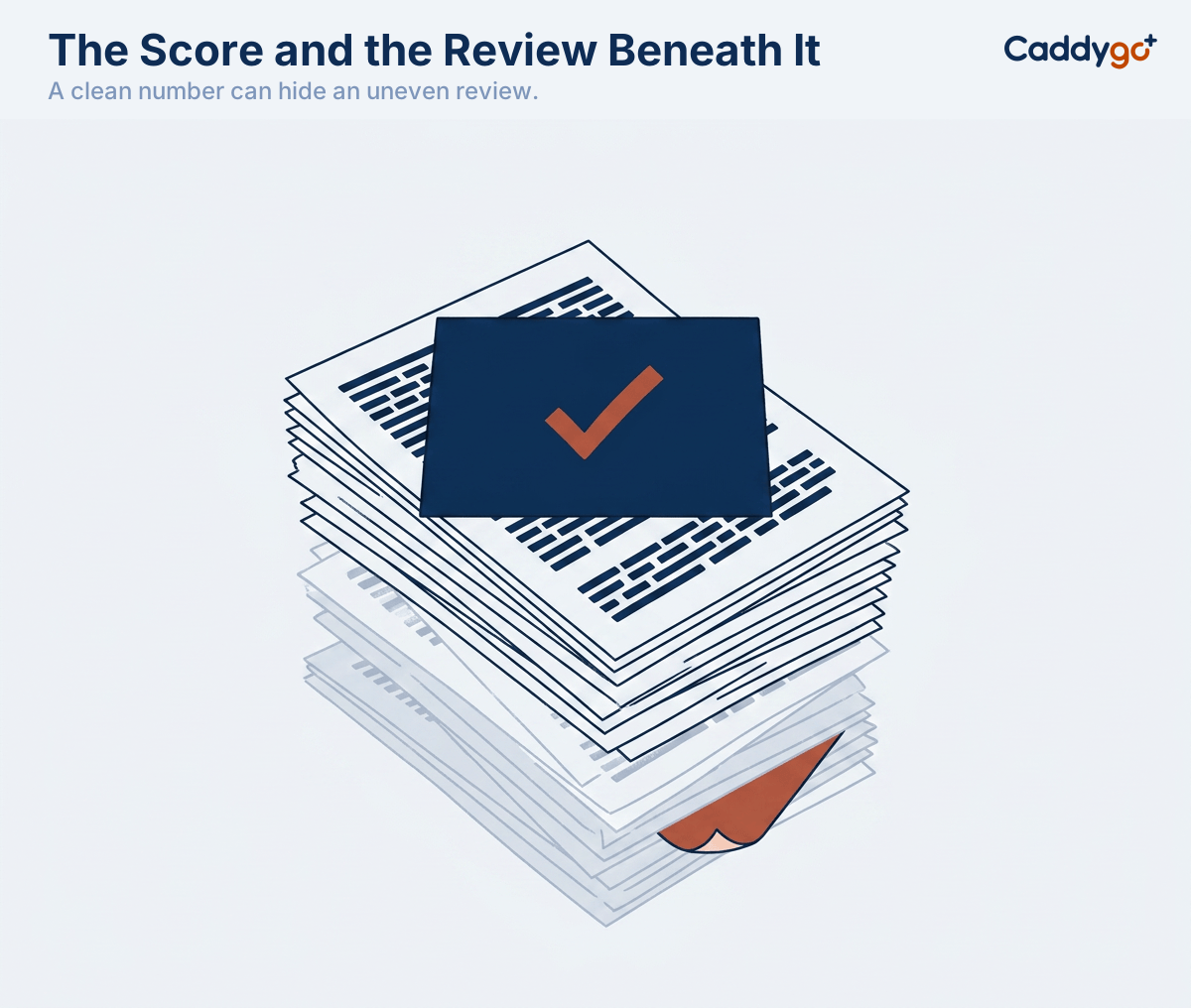
This is the layer AI handles well. It reads the hundredth document with the same care as the first, applying the same criteria to every offer at the same depth, which is the entire point of a comparable score. For most of the routine reviewing, letting AI carry it is how a lean team stays rigorous across a full stack of documents instead of losing ground page by page. The human stays in the loop, now reviewing the AI’s work and the points where it flags its own uncertainty, rather than reading every document from scratch. And crucially, AI can surface most of the factors a case involves, including which internal stakeholders to involve and what to ask them, which is most valuable exactly when the category is new and there is no template to lean on. A person still reviews that first list and adds what is missing, but they are sharpening a draft instead of starting from a blank page.
That frees capacity for the judgment layer, which is where humans belong and where AI adds little. Weighting is not a formula, it is a negotiation about what the business values. Different stakeholders will pull in different directions, and often should. If security pushes its criteria too high, it protects the business in one sense but can work against the person who has to use the solution: a security bar that most vendors cannot clear may leave the business owner with a tool that lacks the functionality they needed. Resolving that is a judgment call, sometimes a political one, and the business owner, the person who will live with the decision, usually deserves the loudest voice. No model can make that trade for you.
There is a second failure that starts even earlier. If the requirements were vague, the offers come back incomparable, and no scoring method can rescue them. A telltale sign is a vendor Q&A round that balloons with clarifying questions, which means the request was not clear enough to answer cleanly. The result is offers built on different assumptions, prices that cannot be compared, and a scorecard measuring things that do not line up. As with any specification, the cost of fixing that gap only grows the later it is found: a fuzzy requirement is cheap to fix before the tender goes out and expensive to fix after the offers are in. Clear requirements are what make a scorecard comparable in the first place, and vague ones are one of the most common reasons offers cannot be compared at all, which is why improving your RFP process upstream decides how much the scorecard can be trusted downstream.
None of this means a scorecard fixes everything. It does not decide what your business should value, and it does not, on its own, guarantee anything happens when a vendor scores poorly. Those remain human and organizational problems. What a trustworthy scorecard does is narrower and real: it makes sure the review beneath the number is consistent, complete, and traceable, so the number reflects the vendors, not how thoroughly each one happened to get reviewed. That is also the difference between a manual procurement review that feels thorough and one that actually is. Handled this way, the scorecard stops being a source of false confidence and starts making procurement visibly the expert in the room.
Building a scorecard you can stand behind
The practical move is to separate the two kinds of work a scorecard depends on. The reading and consistent scoring can and should be systematized, because that is where the volume overwhelms a lean team’s capacity. The weighting and the final call stay with the people who own the outcome. Set your criteria and weights before the offers arrive, decide who scores what, and keep a clear record of why each vendor landed where it did. Handled that way, the score becomes something you can genuinely stand behind.
Frequently asked questions
A vendor evaluation is the broader assessment of a supplier. A vendor scorecard is the structured tool that turns that assessment into comparable scores. In practice, an evaluation scorecard is used at selection to choose a vendor, while a performance scorecard tracks a signed vendor over time.
Fewer than most teams expect. A focused set of criteria, grouped into technical, commercial, service, and compliance, that every stakeholder understands and maintains is more useful than an exhaustive list that blurs the picture. Add a criterion only when it changes a decision.
The weighting is agreed jointly by the stakeholders, but the business owner who will use the solution usually carries the most weight in the decision, since they live with the outcome. Weighting reflects business priorities, so it is a judgment call rather than a fixed formula.
Quarterly is common for active suppliers, with lighter reviews for low-risk vendors and closer monitoring for critical ones. The right cadence is whatever is frequent enough to catch a problem while you can still act on it.
Written by
Data and AI professional since 2016. Built an AI startup in 2020, then trained 100+ procurement professionals at companies like Zalando and Novonesis on AI adoption.
