Why Manual Procurement Review is a Business Risk


Procurement teams reserve their sharpest focus for the most critical cases. That makes sense. But it also means that every other case gets less attention. The routine vendor comparison, the mid-priority renewal, the contract that’s “probably fine.” Those are the cases where business owners feel the missing attention and the missing speed. And that’s where the risk actually lives.
Manual procurement review sounds like a safeguard, but in practice it’s often a liability. Summarizing a 50-page proposal is tedious enough on its own. Add the back-and-forth with stakeholders, the dependencies, the context that gets lost between rounds of review, and the process stretches far beyond what the document itself demands. Hours spent staring at PDFs are equated with the mitigation of risk. But when the review is manual, human error is a bigger factor than most teams admit. The question isn’t whether AI replaces humans. It’s whether ignoring the limits of sustained attention is a risk the business can afford.
When “Thoroughness” Breaks Down
Diligence is often described as a character trait, something a “thorough” person has and a “lazy” person lacks. But diligence is actually a finite resource. It is a state of mind that requires freshness to function.
Most people have had those moments. You’ve stayed up far too late, or you’ve been in back-to-back meetings since 8:00 AM, and by the time you open that vendor proposal, you aren’t the same person you were in the morning. Your ability to spot what is relevant in a sea of information depends entirely on your mental state. Even seasoned experts make measurably inconsistent judgments when the conditions around a decision change.
Procurement specialists are doing demanding cognitive work. If a specialist is handling their 20th procurement event of the year, expecting them to find a buried discrepancy on page 42 of a contract is like asking a marathon runner to sprint their final mile at the same pace as their first. You can be the most dedicated professional in the world, but if your mind isn’t fresh, your “thoroughness” is an illusion.
Why Your Brain Skips the Details
When faced with an overwhelming volume of data, the brain does something rational: it triages. If you need to finish an evaluation and you have 200 pages to read, your first instinct is to identify what is relevant and ignore the rest. The problem is that the most dangerous risks are often hidden in the “irrelevant” sections: the boilerplate, the fine print, the secondary security exhibits. In software procurement, for example, a buried data processing clause can carry more risk than the pricing section the specialist spent most of their time on.
There is a constant trade-off between the depth of context a person can absorb and the freshness of their mind. The deeper you go, the more tired you get. The more tired you get, the more your brain starts “skimming” to reach the finish line. By the time a specialist gets to the final vendor in a shortlist, they are effectively flying blind compared to how they handled the first vendor on Monday morning.
The Friday Afternoon Problem
A stakeholder asks for a shortlist. But in parallel, you also need to revise a contract, negotiate a new deal, search for new vendors, approve purchase orders, chase down a wrong invoice, and clean up master data. By the time you open that 50-page proposal that requires real focus, your attention has already been spent on a dozen other tasks.
This is what procurement actually looks like. Teams are overloaded with administrative work, pulled in by stakeholders who involve them too late or on short notice, and left with little time for the strategic work that matters most: preparing for major negotiations, spending time with suppliers on innovation, reviewing complex offers with the care they deserve.
A rested mind on Monday morning will spot in ten minutes what a depleted mind missed in two hours on Friday. Yet most procurement cultures don’t reward stopping. They reward grinding. And that grind is where the most expensive errors are born.
AI as a Consistency Layer
This is where the conversation shifts from “can the AI think?” to “the AI doesn’t get tired.”
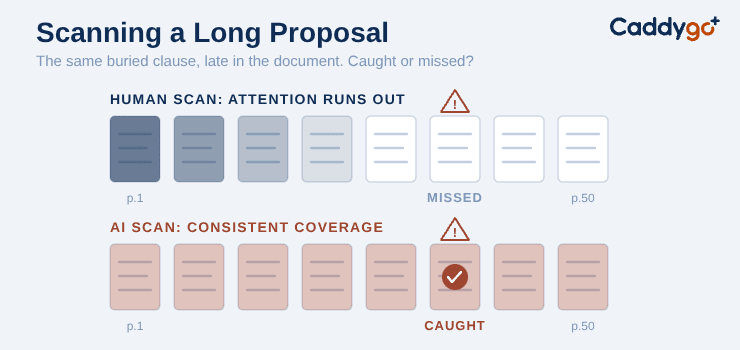
AI performance does not deteriorate with volume. A specialized AI tool doesn’t care if it’s reading the first page or the five-hundredth. This is particularly critical when dealing with what some vendors do deliberately: using sheer volume to hide unfavorable terms or discrepancies in hundreds of pages.
Scanning for those discrepancies is exactly where AI is strong. That said, this is not as simple as plugging in a chatbot. AI tools hallucinate. That’s not a bug that can be fixed. It’s part of how the technology works. Hallucinations can be mitigated, sources can be surfaced, and assumptions can be flagged with confidence indicators, but they can’t be eliminated. The real value comes from a technical setup that makes the output reliable and trustworthy, not one that pretends the AI is always right.
The AI isn’t there to be “smarter” than the specialist. It’s there to be the consistency layer. It handles the tedious scan so the human expert doesn’t have to spend their peak mental hours on the noise.
From Reader to Reviewer
Acknowledging these limits doesn’t diminish the role of the procurement specialist. Counterintuitively, it elevates it. The professional who refuses to use AI today is putting the company in more danger, not less. They are choosing to rely on a fatigue-prone manual process when a more consistent alternative exists.
The role is shifting from “document reader” to “strategic reviewer.” The skills required for this transition are different from what procurement teams needed before, but the first step is simply acknowledging that your brain was never meant to be a PDF scanner.
Think of Jeff Bezos and his famous rule about putting all high-impact meetings in the morning. He is able to do that because he has an entire support system that handles the preparation, the data gathering, and the tedious work. He only applies his fresh mind to the final, most important decisions.
AI now offers that same support system to every procurement specialist. By letting the technology handle the preparation and the exhaustive reading, you ensure that when you finally sit down to make a decision, you’re doing it with the clarity of a Monday morning, even if it’s Friday afternoon. That’s an opportunity for procurement to position itself as a function that delivers faster, more reliable outcomes, not one that’s still grinding through PDFs at 5PM.
Frequently asked questions
Because human attention is a finite resource that degrades with fatigue and volume. Reviewers reserve their sharpest focus for the most critical cases, so routine reviews get less attention, and the most dangerous risks often hide in the boilerplate and fine print that a tired reviewer skims past. Treating hours spent reading PDFs as proof of diligence hides how inconsistent that coverage really is.
In the sections reviewers treat as "irrelevant": the boilerplate, the fine print, and secondary security or data-processing exhibits. In software procurement, a buried data processing clause can carry more risk than the pricing section a specialist spent most of their time on.
No — the point is not replacement, it is consistency. AI performance does not deteriorate with volume, so it can read the first page and the five-hundredth with equal attention, acting as a consistency layer for the tedious scan. Human experts still make the judgment calls; AI simply frees their peak mental hours for the decisions that actually need them.
AI tools do hallucinate, and it cannot be fully eliminated because it is part of how the technology works. It can be mitigated: surfacing sources, flagging assumptions, and adding confidence indicators make the output reliable and trustworthy. The value comes from a technical setup that manages hallucination, not one that pretends the AI is always right.
It is when a specialist finally opens a 50-page proposal after their attention has already been spent on a dozen other tasks — revising contracts, chasing invoices, cleaning up master data. A rested mind on Monday morning can spot in ten minutes what a depleted mind misses in two hours on Friday, yet most procurement cultures reward grinding over stopping.
Written by
Data and AI professional since 2016. Built an AI startup in 2020, then trained 100+ procurement professionals at companies like Zalando and Novonesis on AI adoption.

