Why Speed Is Procurement’s Best Risk Management Tool


Most procurement leaders see speed and risk as opposites: if you move faster, your protection drops. Thoroughness means taking time, and taking time means doing it right.
This assumption is becoming one of the largest unmanaged risks in procurement. When the procurement process becomes a bottleneck, it doesn’t stop the business from buying. It forces the business to find ways around procurement entirely, through corporate credit cards, “pilot” programs, or deals structured specifically to stay under the threshold. In that scenario, procurement speed isn’t a shortcut. It’s a form of risk management.
The Double Standard Between AI and Human Accuracy
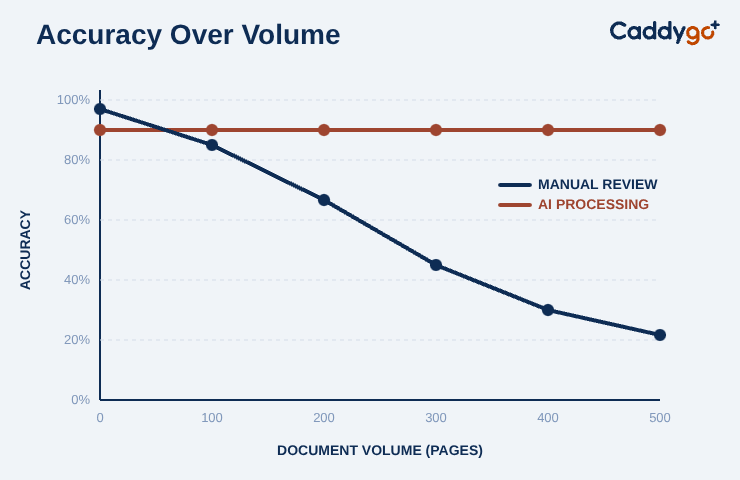
There’s a double standard slowing down AI adoption in procurement. Teams wait for AI to be nearly perfect before allowing it into a workflow, while accepting that human accuracy naturally drops over time.
When a procurement specialist sifts through hundreds of pages of vendor documents, their quality of work degrades. We all get tired, and tired reviewers miss things — a pattern well-documented across professions, from healthcare to finance. AI can process those same hundreds of pages without losing focus. It won’t miss a line item on page 84 because it’s 4 PM on a Friday.
If AI is consistently better at sifting through documents, calculating figures, and sending follow-up emails to vendors, then insisting on a slow, manual process in the name of thoroughness can actually introduce more errors than it prevents. Speed and quality are not mutually exclusive when you match the right task to the right actor.
Why Procurement Speed Depends on Accuracy Calibration
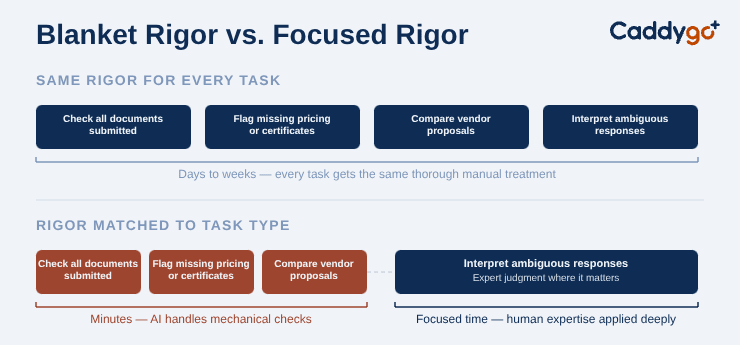
Accuracy works like a spectrum. On one end, you have final contract language and regulatory compliance, where even small mistakes have serious consequences. On the other end, you have initial vendor screening, summarizing proposals, and checking whether a vendor submitted all required documents, where speed to a good-enough answer matters more than perfection.
When you treat a vendor Q&A with the same rigor you apply to a final contract, you’re consuming time without adding protection. If a task has low consequences when a minor mistake occurs, then getting to a good decision quickly is safer for the business than a three-week delay to reach a marginally better one.
Slow turnaround erodes the trust of internal stakeholders. When procurement speed falls behind the pace of the business, business owners structure deals specifically to avoid the process. The gates built to protect the business end up being bypassed entirely.
Procurement Governance Without the Bottleneck
Control gates work best when they’re placed at the moments where human judgment actually makes a difference.
AI can check whether a vendor submitted all required documents. It can flag a blank pricing cell or a missing ISO certificate. A human doesn’t need to be involved in that step. The gate should come when the vendor responds and the information is ambiguous. That’s when you bring in the expert to interpret and decide.
This keeps the human in the loop where it matters, without slowing down everything else.
When finance leaders add more manual checkpoints for control, they sometimes create the opposite effect. The process slows to the point where stakeholders bypass procurement altogether. An AI can apply the same evaluation criteria to 50 vendors consistently, whereas three different buyers might interpret those criteria in three different ways. Consistency at speed is a form of governance, not a shortcut around it.
Procurement Speed as Risk Management
If you can complete an initial offer analysis in minutes rather than days, you’ve removed the incentive for stakeholders to go around procurement. The process stays relevant because it enables the business to move, rather than slowing it down.
This is what procurement speed as risk management looks like in practice. A process that moves quickly through preparation and focuses deeply on decisions is more protective than one that moves slowly through everything. The fastest procurement team isn’t cutting corners. They’re putting their attention where it actually reduces risk.
For procurement leaders, this is an opportunity to redefine what rigor means. Not more time spent, but better decisions made.
Frequently asked questions
When procurement becomes a bottleneck, it does not stop the business from buying — it pushes stakeholders to bypass the process through corporate credit cards, "pilot" programs, or deals structured to stay under the threshold. Moving quickly keeps the process relevant so the control gates actually get used. A fast process that focuses deep scrutiny on real decisions is more protective than a slow one that treats everything the same.
No. They are only opposites when you match the wrong actor to the task. A specialist sifting hundreds of pages gets tired and misses things, while AI can process those same pages without losing focus, so pairing AI's consistency with human judgment lets you move fast and stay accurate at the same time.
It is matching the level of rigor to the consequences of a task. Final contract language and regulatory compliance demand near-perfect accuracy; initial vendor screening, summarizing proposals, and completeness checks need speed to a good-enough answer. Applying contract-level rigor to a vendor Q&A consumes time without adding protection.
At the moments where human judgment actually changes the outcome. AI can check whether a vendor submitted all required documents or flag a missing ISO certificate without a human involved; the gate should come when a response is ambiguous and needs an expert to interpret and decide. This keeps humans in the loop where it matters without slowing everything else down.
Often it does the opposite. Extra manual checkpoints can slow the process to the point where stakeholders bypass procurement altogether, defeating the control they were meant to add. An AI applying the same criteria to 50 vendors consistently is itself a form of governance, whereas three different buyers might interpret those criteria three different ways.
Written by
Data and AI professional since 2016. Built an AI startup in 2020, then trained 100+ procurement professionals at companies like Zalando and Novonesis on AI adoption.

