Procurement Risk Management: The Spend You Never Get To


Ask most procurement teams whether they have a risk management process, and the answer is yes: a framework, a supplier assessment, a risk register, an approval workflow. Ask a harder question and the confidence tends to drop. What share of your spend does that process actually reach?
This guide covers procurement risk management end to end: the main types of risk, the process for managing them, and the strategies that hold up. Then it turns to the part that decides whether any of it is worth much. It is not which risks you track; every team tracks the same few. It is how much of your spend your process actually reaches with them.
What is procurement risk management?
Procurement risk management is the ongoing practice of identifying the risks in how a company sources and buys from outside vendors, judging how likely and how damaging each one is, reducing the ones you can, and monitoring the rest. In practice it runs as a loop: identify, assess, mitigate, monitor.
It matters because procurement sits on the seam between the company and everything it does not control. Whether it is a supplier that fails, a contract that locks in the wrong price, or a purchase that breaks a regulation, each one lands as a cost, a delay, or a compliance problem the business has to absorb. Good risk management is what stops those from arriving as surprises.
The word “ongoing” carries a lot of weight. A risk assessment run once, when a contract is signed, says little about that same supplier a year later, after a change of ownership, a missed delivery, or a new regulation. Risk moves, so the loop has to keep turning. Run as a one-time formality, it mostly produces paperwork.
The main types of procurement risk
Most procurement risk falls into a handful of categories. The list is familiar; what varies from team to team is how reliably each one is actually caught.
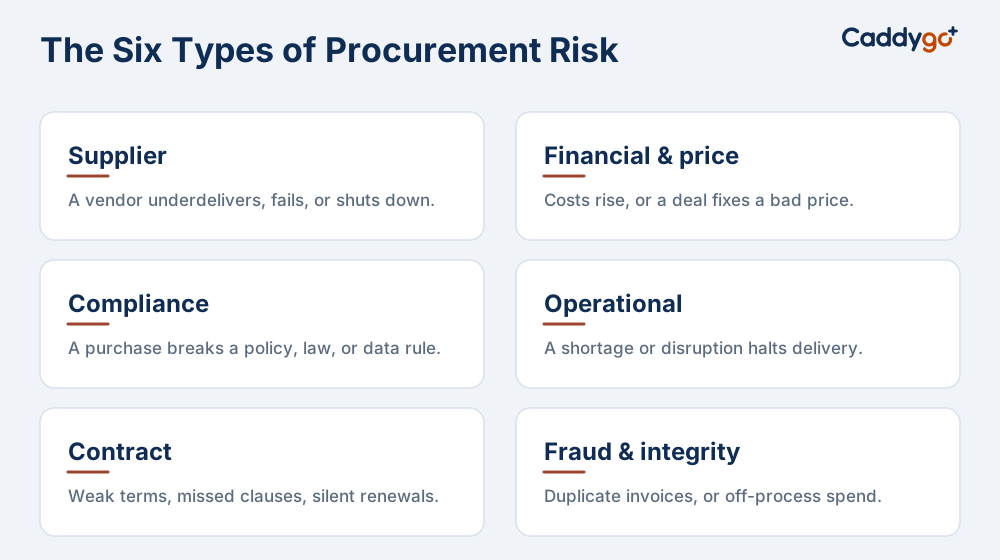
- Supplier risk. A vendor underdelivers, misses deadlines, fails a quality bar, or goes out of business. The sharpest version is concentration: when a single supplier provides something you cannot quickly source elsewhere, their financial trouble becomes your production stoppage. This is why supplier health is worth watching well beyond onboarding, not just at the moment of signing.
- Financial and price risk. Costs rise, currencies move, or a contract fixes a price that looks wrong six months later. A multi-year deal signed without index clauses or review points can quietly turn from a saving into a loss as the market shifts, and often no one revisits it until renewal.
- Compliance and regulatory risk. A purchase breaks internal policy or an external rule, such as data protection, sanctions, industry regulation, or ESG requirements. A vendor that handles customer data without adequate safeguards, for example, exposes you to more than a fine. The audit finding that your own process was not followed can be just as damaging.
- Operational and supply-chain risk. A disruption upstream, whether a shortage, a logistics failure, or a single-source dependency, stops you getting what you need when you need it. Such disruptions have become common: in McKinsey’s 2024 supply chain survey, nine in ten companies reported facing supply-chain challenges that year. These risks often sit one or two tiers back, in a supplier’s own suppliers, where visibility is thin.
- Contract risk. Unfavorable terms, missed clauses, auto-renewals no one tracked, or obligations that quietly lapse. Much of this is decided at signing and only surfaces later, like the software licence that renews for another year before anyone checks whether it is still used.
- Fraud and integrity risk. Inflated invoices, duplicate payments, conflicts of interest, or spend that never went through a process at all. This one clusters in the purchases no one is really looking at, which is exactly where controls tend to be weakest.
How many of these you would reliably catch on a typical purchase, given how your team actually works, is the question the rest of this guide keeps coming back to.
The procurement risk management process, step by step
Managing procurement risk comes down to four stages. The value is less in the stages themselves than in how well each is actually run.
1. Identify. Map where risk can enter across the whole procurement cycle, not only at contract signing: requirements, sourcing, evaluation, contracting, onboarding, and the life of the relationship. In practice this is a standing exercise rather than a one-off, built into how you work through category reviews, a supplier questionnaire, or a short checklist at intake. A risk you never named is one you cannot manage.
2. Assess and prioritise. Judge each risk on how likely it is and how much damage it would do, then rank accordingly. A simple likelihood-and-impact view is usually enough to separate the risks that need active management from the ones you can knowingly accept. The point is to put limited effort where the exposure is largest, and this is where a risk matrix earns or loses its keep, depending on whether anyone acts on what it shows.
3. Mitigate. Reduce the risks you can, and decide deliberately which ones to accept. That might mean adding a review step, negotiating a clause, qualifying a second supplier, requiring a certification, or declining a vendor that cannot meet a requirement. Controls work best embedded into the sourcing and contracting workflow rather than bolted on afterwards, so the right check happens at the right moment instead of relying on someone remembering to run it.
4. Monitor. Keep watching after the contract is signed. Supplier health, delivery performance, compliance status, and market conditions all change, and a one-time check will not catch a problem that appears in month eighteen. The workable version is a small set of signals tracked per supplier, with a clear owner who acts when one moves. Continuous monitoring is the difference between managing risk and documenting it once.
The four stages are not complicated. The difficulty, as any procurement team will tell you, is running them consistently, across everything, with the capacity you actually have.
Mitigation strategies that hold up
A handful of practical measures do most of the work, and none of them are exotic:
- Qualify and diversify suppliers. Vet a supplier before you commit, and keep a viable alternative for the categories you cannot afford to lose, so a single failure does not become your failure. In Deloitte’s global survey of procurement leaders, keeping active alternative sources was the mitigation rated most effective. For critical items, a pre-approved second source is cheap insurance.
- Tighten the contract. Clear terms, review and exit clauses, service levels, and tracked obligations prevent the slow contract risks that otherwise surface years later. The contract is where you set the price of things going wrong, so it is worth the time.
- Monitor continuously, not annually. Signals like delivery slippage, a change in a supplier’s financial health, or a missed compliance renewal only help if someone sees them in time to act. An annual review tends to catch problems about a year late.
- Keep controls proportionate. A control heavier than the risk it manages slows the business down without buying much safety, and a control too slow to use gets bypassed altogether. Match the depth of the check to the size of the risk, which is a point the next section takes head-on.
The spend your process never reaches
Come back to the question this guide opened with: what share of your spend does the process actually reach? For most teams the honest answer is small, because a rigorous risk process is only as good as the share of spend it covers. This is not a seventh risk to add to the list. Everyone already knows the six categories. It is the thing that decides how many of them you actually catch, because a risk you never check a given purchase for is one you are exposed to whether or not it has a name.
The reason is capacity, not carelessness. Real risk assessment is manual and slow. Comparing offers means pulling every vendor’s documents into one view and reconciling them line by line, commercially, legally, and technically. On a single tender with, say, eighty questions and five suppliers, a team can spend two weeks working through the answers by hand. Done properly, that can only happen for the large, strategic deals. Everything else, the tactical spend and the long tail of smaller, one-off purchases, goes through with a light touch or none at all.
That tail is not a deliberate category. One procurement leader described it bluntly as “a marker of no grips,” meaning the residue of a team that never had the capacity to get a proper hold on it, rather than a considered decision to leave it unmanaged. And it is exactly where the uncomfortable risks from that list live: duplicate payments, unvetted suppliers, quiet compliance and data-protection gaps, and spend that skipped the process entirely.
So the typical picture is the opposite of reassuring. The rigorous process runs on the strategic suppliers, which are already the most scrutinised and the least likely to surprise you. The register gets filled in, filed, and rarely consulted again. Meanwhile the spend most likely to hide a problem gets the least attention. A well-documented process wrapped around the safe part of your spend is not simply incomplete. It can be worse than incomplete, because it manufactures a confidence the coverage does not justify.
The honest response is not to force the same manual rigor onto everything. You cannot, and piling on more manual checks only slows the business down. The lever that matters is capacity: the tactical and tail spend goes uncovered for the same reason risk management is short-changed everywhere, because execution consumes the hours that real assessment needs. Risk management is the classic important-but-rarely-urgent task, and every week it loses to the execution work that has to happen now. Free that capacity and it stops losing.
That is what shifts as AI agents take over the execution layer of procurement. Most of a team’s time goes into execution: running sourcing events, comparing offers, chasing missing information, processing routine spend. As that work moves to AI agents, fully automated where the stakes are low and part-automated where they are higher, the capacity locked in the grind is freed across the whole function, not only in sourcing. That is what finally makes room for the ongoing, across-the-board risk assessment that never fit before, on a sensible bar: the result has to be net positive, not perfect, the same standard already accepted from people.
None of the six risk types changes in this. Supplier, financial, compliance, operational, contract, and fraud are the same list they always were; what changes is how much of your spend actually gets checked against them. And AI does more than hand back time. It can make the risk work itself more proactive, monitoring suppliers and spend continuously and flagging a change as it happens rather than at the next annual review, so the process starts watching in real time instead of catching problems a year late. People stay in control of the judgment, moving into more of a reviewer role, while the routine execution and monitoring run underneath.
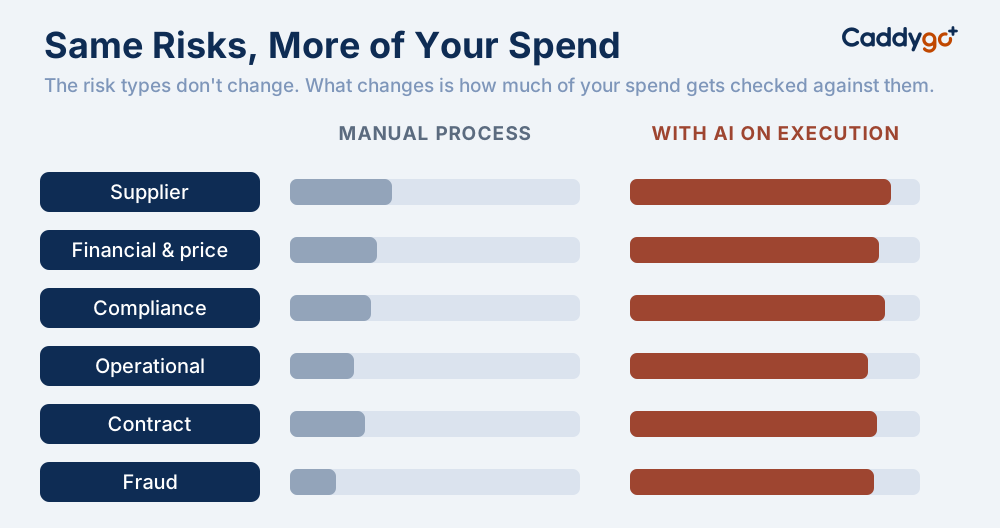
None of this is a stretch. People cannot simply “handle more,” because manual review at volume becomes a business risk of its own; and a process that stays slow gets routed around, because when procurement cannot keep up, the business bypasses it, which puts the spend outside any control at all. The framework was never the real constraint; the capacity to apply it was, and that is what AI removes.
What good procurement risk management looks like
Take the external threats seriously: suppliers, prices, compliance, disruptions. Run the four-stage loop and the standard mitigations well. But judge the whole effort by a measure the frameworks leave out. Not whether you have a rigorous process, but how much of your spend it actually reaches. A perfect register on your top twenty suppliers, sitting next to a long tail that never sees a check, is not risk under control. It only looks like it. The teams that treat coverage as the goal that matters, and use automation to extend good-enough rigor into the spend that currently escapes it, are the ones whose risk management holds up when it is tested. It is also the more rewarding version of the job: less time spent producing risk paperwork, and more spent actually keeping the business out of trouble, which is where procurement adds the most value.
Frequently asked questions
Supplier, financial and price, compliance and regulatory, operational and supply-chain, contract, and fraud or integrity risk. A practical way to prioritise them is by how likely each is and how much damage it would do.
Four stages: identify risks across the whole procurement cycle, assess and prioritise them, mitigate the ones you can, and monitor continuously after signing. The hard part is not the steps but running them consistently across all of your spend, not only the large deals.
Because thorough risk assessment is manual and time-consuming, teams can usually only apply it to their biggest, most visible suppliers. The long tail of smaller purchases tends to bypass the process, and that is where problems like duplicate payments, unvetted suppliers, and compliance gaps often hide. Extending coverage to that tail is largely a capacity problem, increasingly solvable by automating the routine parts of review.
Written by
Data and AI professional since 2016. Built an AI startup in 2020, then trained 100+ procurement professionals at companies like Zalando and Novonesis on AI adoption.

